- Home
- Iso-Thixotropy
- Air Pressure
- Airplanes
- Cartesian Diver
- Slime
- Sound
- Links


Cartesian Diver
This experiment demonstrates the property of buoyancy.
Materials
- 2-liter soda bottle and its cap or some other 'squeezable' clear plastic bottle
- Small container such as a large water glass or bowl
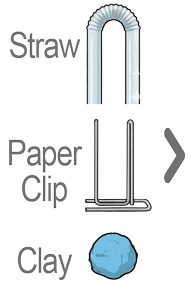
- Glass or plastic medicine dropper (one that sinks in water) - OR plastic bendable drinking straws, a paper clip, and some modeling clay.
 Procedure
Take the empty soda bottle and fill it completely with water. Fill the water glass with water and place the medicine dropper in the glass. Get some water inside the dropper by squeezing the rubber bulb while the end is in the water. You want to get the dropper to just barely float upright in the water. Once you've done this, place the dropper in the soda bottle and screw on the cap tightly.
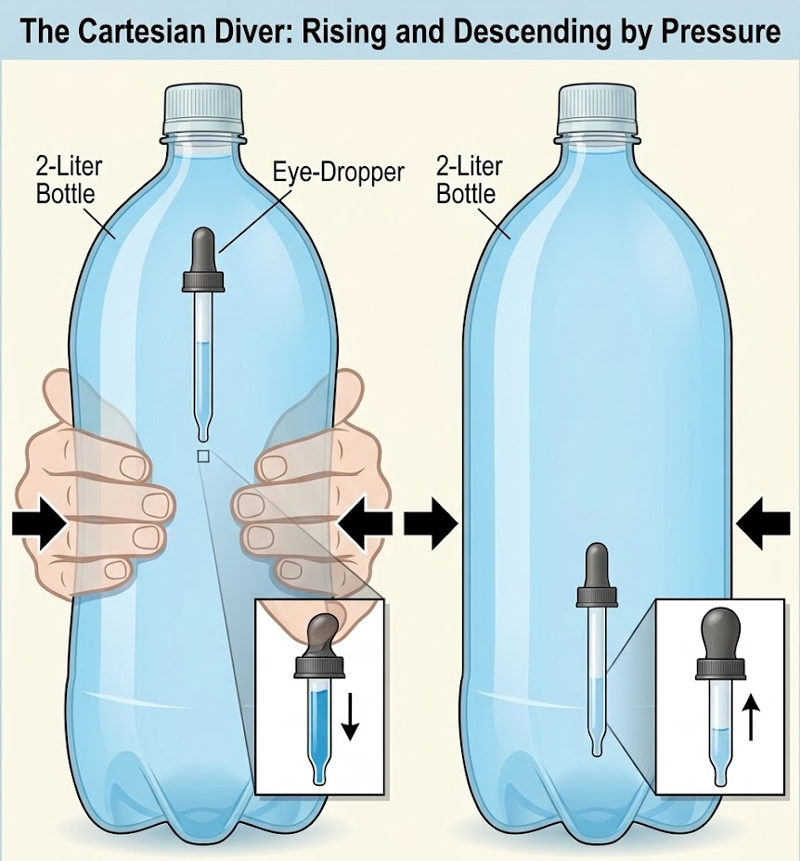
Don't allow much air to be between the top of the bottle and the cap. Gently squeeze the bottle. As you squeeze, the diver will dive (sink) to the bottom of the bottle. If you stop squeezing, the diver will float back to the top.
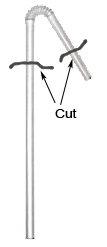 If you can't find a medicine dropper, you can duplicate the same effect by
bending half of a plastic drinking straw in half and securing it with a paper
clip. Put a small amount of modeling clay on the bottom end of the straw and,
like the medicine dropper, just get it to barely float on the surface of the
water in the water glass.
If you can't find a medicine dropper, you can duplicate the same effect by
bending half of a plastic drinking straw in half and securing it with a paper
clip. Put a small amount of modeling clay on the bottom end of the straw and,
like the medicine dropper, just get it to barely float on the surface of the
water in the water glass.
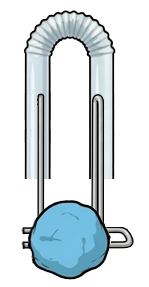
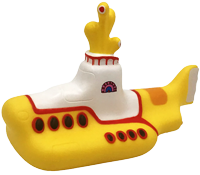
Now think of some other 'submarines' to make and try...
 What's Going On?
This experiment demonstrates the property of buoyancy. An object is buoyant
in water due to the amount of water it displaces or 'pushes aside'. If the
weight of water that is displaced by an object in water exceeds the weight
of the object then the object will float. As you apply pressure to the bottle,
you apply pressure to the air bubble in the dropper reducing its size. As the
bubble's size reduces, the dropper becomes less buoyant and begins to sink.
Release the pressure on the bottle and the dropper begins to rise back to the top.
Most fish keep themselves from either sinking or floating to the surface by using
muscles to squeeze or relax a small air bladder or sac (with a small air bubble inside).
These fish have this sac inside their bodies. By squeezing the sac smaller, the fish will sink.
By relaxing their muscles, the sac increases in size, displaces more water, and a fish will begin to
rise to the surface. Man uses this same principle to control the buoyancy of a
submarine. By pumping water in and out of tanks stored in the submarine, a
submarine can be made to rise and sink.
Mess Factor
Just the possibility of getting a little wet.
 Things to Remember
Cartesian is a term that was named after René Descartes, a French scientist, mathematician, and philosopher. He laid the foundations of analytical geometry, algebra, and other subjects such as buoyancy and pressure. René Descartes sought truth by first doubting everything, even his own existence. But he concluded that in order to be able to doubt his existence, he must exist.