Still Confused About What to Do?
That's OK! There are a lot of aspects to this hobby. There are numerous clubs and organizations worldwide that run contests, races, and other events. There's even a world championship where each country has a team and competes for significant prize money.
My interest in the hobby all started when I first visited the San Diego area in California known as La Jolla in the late 1970's. There's a very famous slope soaring hill above Black's Beach known as Torrey Pines Glider Port, near the Scripps Institute. I saw a purple slope plane that was obviously scratch-built, flying like no plane I'd ever seen — high speed passes, multiple rolls, inverted flight. That was enough for me.

my first R/C sailplane
Many, many years ago when I started in this hobby, we didn't have the Internet or mail-order where you could buy modeling things, so I visited a local hobby store. Luckily, the owner pointed me at a beginner glider known as the Airtronics Super Questor and told me to get a 4-channel radio right at the start rather than those 2-channel, 2-stick cheapo radios. I bought the plane that day, but had to save up for the radio as it was more than $150 (in 1973)!
I took that new plane kit home and my mother graciously allowed me to build it on the kitchen table (Thanks Mom!). I actually followed the instructions in the kit — this was and still IS a good idea. Most of the best kits out there were originally developed from scratch-built designs by regular R/C flyers and painstakingly turned into kits.
Here's what that [scary] Super Questor plan was in that kit:
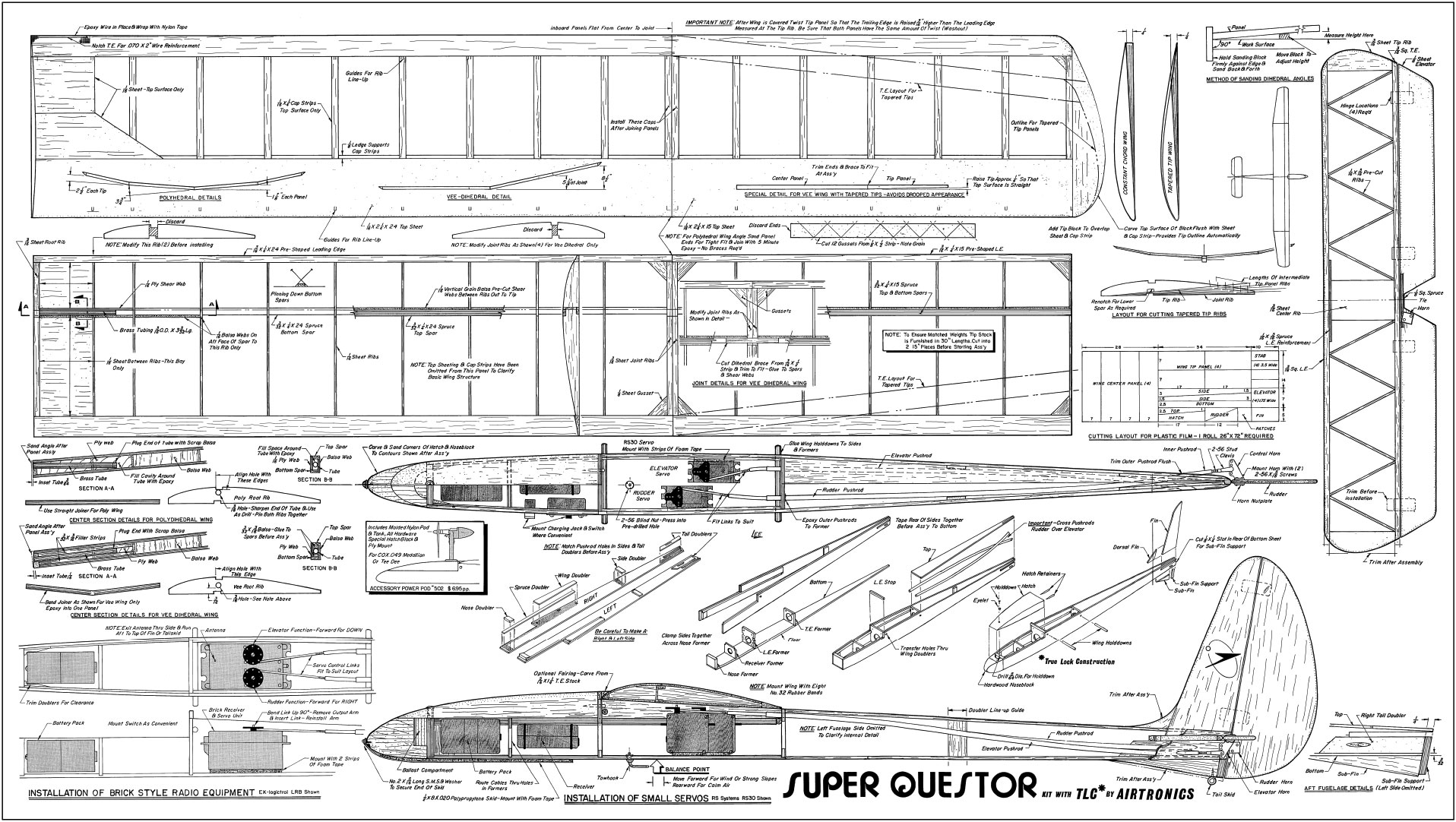
Click to enlarge
Building the Super Questor was one of highlights of my early life!
Building & Installing the Radio

When installing the radio: put the receiver, battery pack, and servos into the fuselage in approximate mounting locations and see how close to the CG you are. It is VERY important to get the balance point at the position indicated in the instructions. It may be necessary to add some weight to the nose adjacent to the battery.
Mount servos securely — do NOT use foam tape. This is one step that older kits used to have you do, attach with foam tape. No. Don't do that! Instead, install two 'rails' of hard balsa between the fuselage sides and use the small screws and grommets from each servo to screw the servos down. I've seen many planes lose control because servos came loose from foam tape, especially after hard landings.
Before flying: Make sure control surfaces move the correct direction. For rudder, move the stick right → surface moves right (viewed from behind). For elevator, pull back → surface moves up. It is REALLY important to have your plane setup so that pulling back on the stick raises the elevator up! - Especially if there's a seasoned pilot ready to help you fly!