

Slope Sailplanes
Some slope planes tend to look like fighter planes and others can have long, thin, razor-sharp wings. However, I have flown some of my older, retired engine-powered planes on a slope too (minus the engine as you don't need it there).
 Slope sailplanes are usually launched by tossing or throwing your planes into the wind while standing near the
the top of a slope. As the plane leaves your hand and enters the lift generated
by the slope, the plane will either rise (if made to fly slower, usually by
pulling back on the elevator "stick" to give it up elevator) or gain speed.
On the slope or in a thermal, sailplanes are always moving downwards thru the air.
If the air below the plane is rising, either from the slope or thermal, faster than the plane's descent rate,
the plane will rise. Some slope lift can be quite strong. Strong enough, in some cases,
to fly planes designed for gas or electric power (without the engine or motor running) quite well.
On some of those 'booming lift' days it feels as though you could fly your
radio transmitter or a sandwich from your lunchbox...
Slope sailplanes are usually launched by tossing or throwing your planes into the wind while standing near the
the top of a slope. As the plane leaves your hand and enters the lift generated
by the slope, the plane will either rise (if made to fly slower, usually by
pulling back on the elevator "stick" to give it up elevator) or gain speed.
On the slope or in a thermal, sailplanes are always moving downwards thru the air.
If the air below the plane is rising, either from the slope or thermal, faster than the plane's descent rate,
the plane will rise. Some slope lift can be quite strong. Strong enough, in some cases,
to fly planes designed for gas or electric power (without the engine or motor running) quite well.
On some of those 'booming lift' days it feels as though you could fly your
radio transmitter or a sandwich from your lunchbox...
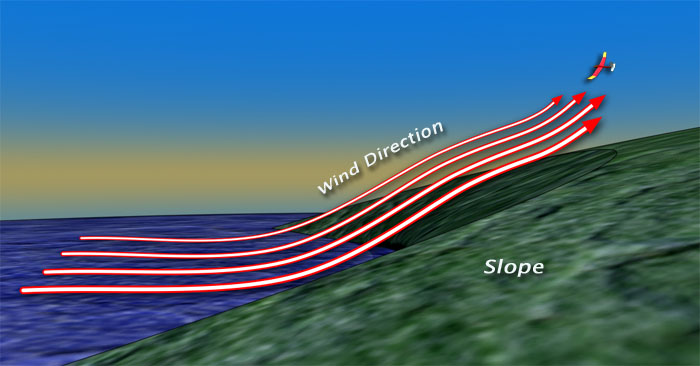
Most good flying slopes are hills or cliffs where the wind strikes the surface of a slope and rises as it is forced upwards due to the shape of the hill. The wind should blow directly against the face of the slope for maximum lift. However, if the prevailing wind doesn't strike the hill nearly 'straight on' or mostly perpendicular, the wind might end up blowing around the face of the hill instead. This will result in lots of wind blowing in your face, but no lift available for flying. Another thing that can affect the lift on a slope is whether there is a mountain or other hill within a half of a mile or so in front of the slope. Instead of the air lifting as it reaches the slope, it has a tendency to rise and fall often containing severe turbulence and unpredictability. It can make it impossible to control your plane or have any fun while flying on this kind of slope. Another thing to note is the top of the slope: on top, just back from the edge of the hill, the lift sometimes stops abruptly or spin towards the ground causing turbulence and other "rotors" that can cause the plane to pitch wildly as it nears the ground or there sometimes is no lift at all.
If you're shopping around for a slope that no one flies, it is better if you find a slope with a smoother, more rounded top. Hopefully not covered by rocks either as the rocks have this ability to 'jump' in the way of a landing plane! Additionally, please don't try to fly near power lines or too close to someone's house. Both of these can be dangerous if something bad happens while flying.
Here's a diagram of a nicely shaped hill where the wind moves straight in from the ocean or another un-obstructed surface and moves up the hill to generate lift for flying.
|
On strong wind or strong lift days, it is not advisable to fly a lightweight trainer or a handlaunch on the slope as it can be very difficult to land a plane and, in some cases, the plane can be wrecked even by experienced pilots due to the turbulence that can occur in such conditions, especially on the top or back edge of a slope, where wind there can be known as the the 'rotor'.
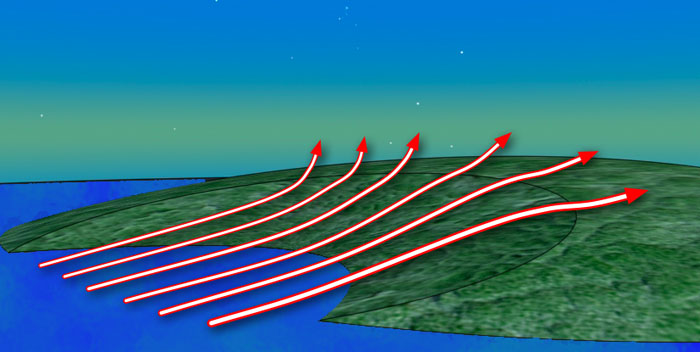
A perfect slope can be sometimes where the hill is in the shape of a bowl. That shape concentrates the wind to maximize upwards lift and often allows uniform lift all the way along the entire slope. The wind has no other direction to move except upwards. I have found this type of slope to be ideal. Just remember that lots of wind doesn't mean lots of lift. I've flown on slopes that were bowl-shaped in only 3-4 mph wind speed where the lift was simply tremendous.
Here's another diagram illustrating what I am saying:
|
Also, there is a type of slope soaring that has become very popular these days called 'Combat' slope flying. The goal of this kind of flying is to essentially knock others out-of-the-air. You get 'points' for hits, but the goal is to knock 'em down as many times as you can in an afternoon. There are companies that are now producing sailplanes specifically for this purpose as well. Click here to read all about Combat planes.
Here's some external slope soaring videos of low-to-the-ground (ultrabatics) with Ahi and other planes:
Novice / Beginner
- Banggood "XK A800" 31" span motor glider
- BASH Enterprises "MONGO Jr." 72" span large flying wing
- Hobby King "Bixler EPO" - 55" span, EPO foam motor glider
- Horizon Hobby "UMX Radian BNF" - 30" span, lightweight motor glider
- Horizon Hobby "Night Radian" - 78" span, motor glider with night lights!
-
 Multiplex (MPX) "EasyGlider 4" 71" span, molded Elapor construction
 - Sig "Riser" 78" span, balsa wood construction
Intermediate
- Aloft Hobbies "Alpha" - 79" span, fiberglass layup
- Aloft Hobbies "Faun 1.5" - 60" span, sheeted foam core hlg/sloper
- Aloft Hobbies "Gremlin" - 60" span, sport glider
- Aloft Hobbies "Magnus 60 Carbon" - 60" span, sport glider
- Aloft Hobbies "Marjoram 2" - 47" span, motor glider, built-up construction
- Aloft Hobbies "Mibo Mini Terminator" - 60" span, hollow molded CNC
- Aloft Hobbies "Mini ASK21" - 51" span, balsa-sheeted wing, fiberglass fuse
- Aloft Hobbies "Mini FOX-G2" - 49" span, balsa-sheeted wing, fiberglass fuse
- Aloft Hobbies "Mini Q" - 32" span, composite wing
- Aloft Hobbies "Prodij HM" - 60" span, hollow molded wing
- Aloft Hobbies "Sera - DS-X" - 60" span, balsa sheeted, built-up wings
- Aloft Hobbies "Sera - 1.9m" - 74" span, sheeted wood/foam and fiberglass
- Aloft Hobbies "Spin 1.5" - 60" span, glassed wood construction
- Aloft Hobbies "SST" - 48" span, EPP foam wing
- Art Hobby "Colibri 1M" - 39" span, 80% ARF, also handlaunch
- Art Hobby "Colibri-V 1M" - 39" span, also handlaunch
- Art Hobby "Colibri-V 1M" - 39" span, also handlaunch
- Art Hobby "Falco-V 1.5M" - 59" span, handlaunch
- Art Hobby "Serena-V" - 79" span
- Art Hobby "Serena-C" - 79" span
- Art Hobby "Serena-RES" - 79" span
- Art Hobby "Skua 1.5M" - 59" span, handlaunch & slope
- Art Hobby "Tigre 1.4M" - 56" span, flying wing
- Art Hobby "Zuni 1.2M" - 47" span, handlaunch & slope
- Art Hobby "Zuni-DL 1.2M" - 47" span, handlaunch & slope
- Art Hobby "Serena 2M" - 79" span, multipurpose
- Art Hobby "Sky 1.7M" - 67" span, multipurpose, conventional tail
- BASH Enterprises "MONGO Sr." 96" span giant flying wing
- DJ Aerotech "Chrysalis 1.5M" - 59" span, wood construction
- DJ Aerotech "Chrysalis 2M" - 78.5" span, wood construction
- Dream-Flight "Ahi" 47.2" span, ultrabatic, freestyle sloper
- Dream-Flight "Alula-TREK" 35.4" span, ultrabatic, lightweight wing sloper
- Dream-Flight "Libelle" 47.2" span, hlg/dlg style-lightweight
- Dream-Flight "Weasel-TREK" 35.4" span, lightweight wing sloper
- ICare "Nemesis" 60" span, ARF molded construction
- ICare "Ocelot" 58" span, ARF molded construction racer
- ICare "The Bizz" 48" span, EPP/Blue foam flying wing
- Muller "Mini Ellipse" - 58" span, molded soarer
-
Multiplex "FunWing" 45.7" span, Elapor & EPP wing
-
Multiplex "Xeno Uni" 49" span, Elapor wing
- North County Flying Machines "Bluto" 56" span, EPP construction, flying wing
- North County Flying Machines "HP60" 60" span wing
- North County Flying Machines "M60" 60" span, EPP construction, DS flying wing
- North County Flying Machines "The Halfpipe" 48" span, speed wing
- North County Flying Machines "The Moth" 48" span, EPP flying wing
- North County Flying Machines "The Halfbad" 24" span wing
- North County Flying Machines "The Wabbit" 24" span wing (w/ servos and battery)
- Off The Edge "Super Drongo Plank" 60" span, plank-style combat wing
- Off The Edge "MiG3" 48" span, combat fighter
- Off The Edge "Scorpion" 48" span, combat wing
- Off The Edge "Wasp" 30" span, mini-wing
- Off The Edge "Zipper" 48" & 60" span, wing
- RC Direct "Opus W" 74.5" span, molded, hi performance racer
- RnR "Revolution" 60" span, t-tail molded composite
- RPV Industries "Cyclone" 60" span, all EPP slope racer (where's Rick Powers?)
- Sig "Ninja" 58" span, foam/wood construction
- Soaring USA "Beach Sailplane" 83" span, 2-Piece T-Tail sloper
- Soaring USA "Bird 60" 60" span, One-Piece Wing sloper
- Soaring USA "Bird Carbon" 58" span, One-Piece Wing & Tail, Carbon
- Soaring USA "Blade" 75" span, Glass/Balsa Wing, V-Tail
- Soaring USA "Blade Carbon" 75" span, V-Tail
- Soaring USA "Blade XL" 98" span, Carbon-reinforced wing, V-Tail
- Soaring USA "Blade XL Carbon" 98" span, Carbon-skinned wing, V-Tail
- Soaring USA "Destiny" 54" span, One-Piece Wing, Carbon
- Soaring USA "Destiny Carbon" 54" span, One-Piece Wing, Carbon
- Soaring USA "Mini Destiny" 45" span, One-Piece Wing, Carbon
- Soaring USA "Dorado Carbon" 94" span, Carbon-skinned wing, V-Tail
- Soaring USA "Graecalis" 114" span, Molded fiberglass, carbon-reinforced
- Soaring USA "Omega 2M" 79" span, kevlar, 2-piece wing
- Soaring USA "Taser Unplugged Carbon" 79" span, carbon, 2-piece wing
- Soaring USA "Terminator Carbon" 27" span, molded-carbon T-Tail
- Soaring USA "Triffik" 27" span, molded-fiberglass T-Tail
- Soaring USA "Tucan Glass" - 79" 2-meter speedster
- Soaring USA "Vector III Carbon" 79" span, molded sloper
- Soaring USA "Volcano" 144" span, Fiberglass molded sloper
- Soaring USA "Wasabi Aerobat" 60" span, carbon composite Racer
- Soaring USA "Whisper 2M" 79" span, 2-piece wing
- Trick R/C "Zagi THC" 48" span, EPP (Light Lift) wing
- Trick R/C "Zagi 5C" 48" span, EPP (Combat) wing
- Windrider "Conscendo Evolution" 59" span, motor glider
- Windrider "Boeing 737-700" 75" span, EPS ARF
- Windrider "Bee 48" 48" span, EPP flying wing
- Windrider "Bee 60" 60" span, EPP flying wing
- Windrider "Fox" 66" span
- Windrider "Windrider Swift S1" 87" span
Advanced/ Contest/ Not For Beginners
- ICare "Eraser Xtreme" 124" span, ARF molded construction
- ICare "Hades" 110" span, ARF molded construction
- ICare "Hera" 122" span, ARF molded construction
- ICare "Kulbutin" 71.5" span, ARF fiberglass semi-scale
- ICare "Nyx" 126" span, ARF kevlar/carbon construction
- RnR "Eagle SS" 112.5" span, F3B
- RnR "Millennium" 123" span, thermal duration
- RnR "Synergy III" 170" span, F3B
- Soaring USA "Cappuccino" - 104" span, slope sailplane
- Soaring USA "Emotion Carbon" - 79" span
- Soaring USA "Scorpion II" 60" span, Carbon Racer
- Soaring USA "Scorpion II Bagged" 60" span, Carbon, Bagged-Wing Racer
- Soaring USA "Spider-Sixty" 59" span, Carbon/Glass/Wood Composite
- Soaring USA "Spider-Sixty Carbon" 59" span, Carbon Composite
- Soaring USA "Spider 2.5 E-Carbon" 59" span, Carbon Composite
- Soaring USA "Spider 2.5-Carbon" 59" span, Carbon Composite
- Soaring USA "X-Wing" 60" span, All-Molded Wing
Combat
- Combat planes are over here.
